How to take peptides, sub-q, IM, nasal, or oral
What each administration route actually means, why peptides are matched to specific routes, and how to read 'route' on a peptide entry.
In this guide · 6 sections+
- 01 · Subcutaneous (sub-q), the default for most peptides
- 02 · Intramuscular (IM), deeper, slower release for some peptides
- 03 · Intranasal, for peptides that work on the brain or that don't survive the gut
- 04 · Oral, only if it survives stomach acid
- 05 · Topical, for skin and follicle peptides
- 06 · Picking the right route
'Route' on a peptide page tells you how the compound is delivered. Different peptides require different routes because of how the molecule survives or fails in your body. Picking the wrong route either does nothing (peptide degrades) or misses the target tissue.
Five routes you'll see on Pepdex: subcutaneous, intramuscular, intranasal, oral, and topical.
Subcutaneous (sub-q), the default for most peptides
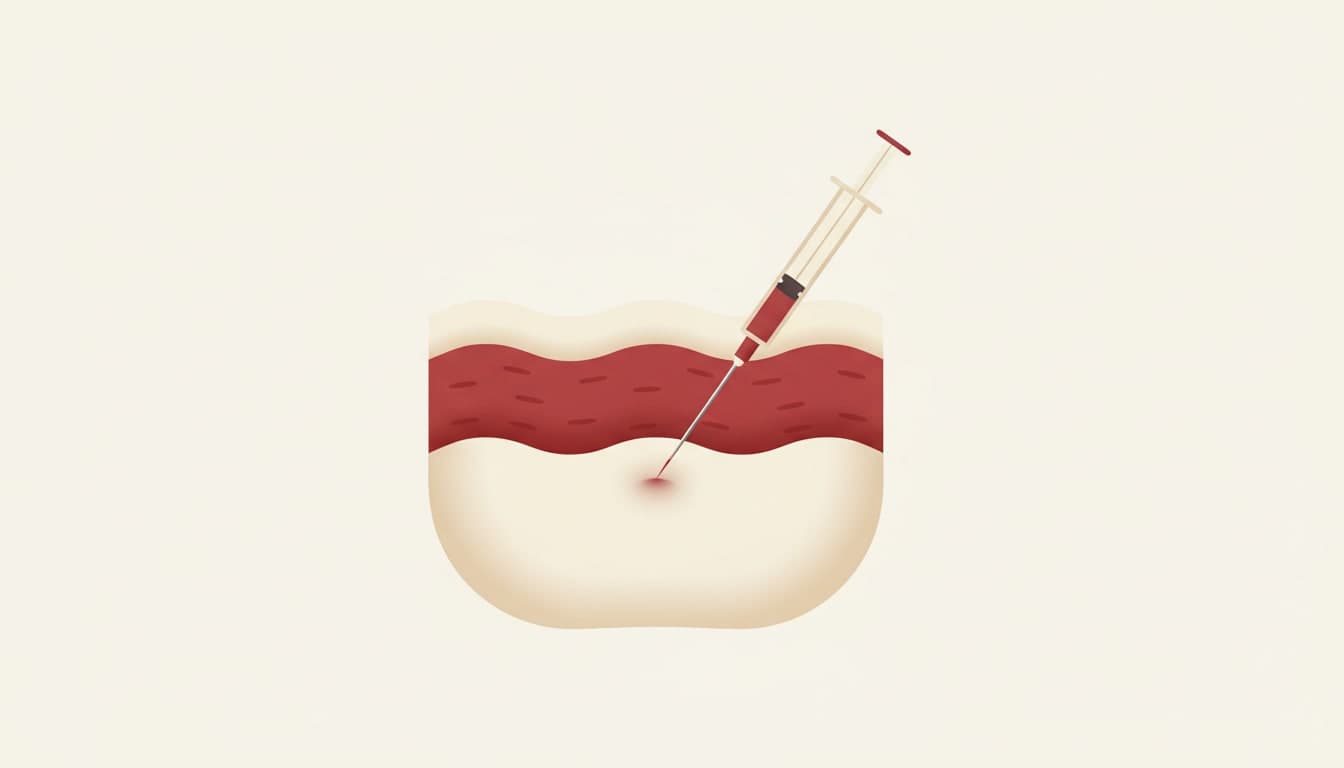
What it is: injection into the fat layer just under the skin. Not into muscle, not into a vein.
Why it's the default: it's slow-absorption (the peptide diffuses gradually from the fat depot into circulation), which preserves the natural pulse pattern your body uses for many of these signals. It's also low-effort, small needle (29-31 gauge insulin syringe), shallow angle, minimal pain.
What's typically sub-q: BPC-157, TB-500, Ipamorelin, CJC-1295, GHK-Cu, MT-1, MT-2, Tesamorelin, Sermorelin, Hexarelin, IGF-1 LR3 / DES, MOTS-c, Cagrilintide, Survodutide, Mazdutide, Pemvidutide, Petrelintide, Amycretin, Liraglutide, Semaglutide, Tirzepatide, Retatrutide, Setmelanotide, Pramlintide, Teduglutide, Teriparatide.
Sites: lower abdomen (2 inches from navel), love handles, outer thigh, back of upper arm. Rotate per dose to avoid lumps under the skin (lipohypertrophy).
Intramuscular (IM), deeper, slower release for some peptides
What it is: injection through skin and fat into the muscle. Larger needle (23-25 gauge, 1-1.5 inch), slightly more painful.
Why some peptides go IM: muscle has more blood supply than fat, so absorption can be faster initially but the depot effect lasts longer because the larger volume holds. For TB-500 loading-phase doses (2-2.5mg twice weekly), some users go IM. Octreotide LAR is exclusively IM (it's a 30-day depot formulation). Cerebrolysin is typically IM in clinical use.
Sites: outer deltoid, vastus lateralis (outer mid-thigh), gluteus medius (upper outer butt). Aspirate gently before injecting to verify you're not in a vessel.
Intranasal, for peptides that work on the brain or that don't survive the gut
What it is: spray into the nasal cavity. The nasal mucosa is thin and rich with capillaries, so peptides absorb directly into the bloodstream and (for some compounds) bypass the blood-brain barrier more efficiently than systemic injection.
Why some peptides are nasal: Selank and Semax are the canonical examples, both are nootropic / anxiolytic peptides where the goal is brain delivery. Oxytocin is dosed intranasally for off-label social/anxiety use. VIP in the Shoemaker CIRS protocol is intranasal. PT-141 has been studied intranasally though the FDA-approved Vyleesi formulation is sub-q.
Practical note: requires a different reconstitution setup with BAK preservative (not standard BAC water), see the Reconstitution guide.
Oral, only if it survives stomach acid
What it is: swallowed (capsule, tablet, or oil suspension).
The challenge: most peptides get destroyed by stomach acid and digestive enzymes before they reach circulation. The peptides you can take orally either have structural protection (small molecules that mimic peptide function, MK-677 isn't technically a peptide), or they target the gut directly (oral BPC-157 acts locally on intestinal lining), or they're lipophilic enough to absorb via the lymphatic system.
Common oral compounds: MK-677 (small molecule), 5-Amino-1MQ (small molecule), Dihexa (oral or transdermal), and oral BPC-157 (specifically for gut applications, not systemic). Foundayo (orforglipron) is an oral GLP-1 small molecule.
What's NOT oral: virtually every other peptide on Pepdex. Don't try to swallow injectable BPC-157 expecting systemic effect, the gut effect is real, the systemic effect is much weaker.
Topical, for skin and follicle peptides
What it is: applied to the skin as a serum, cream, or lotion.
Why it's used: GHK-Cu, AHK-Cu, and SNAP-8 work locally on skin or follicle cells without needing systemic distribution. Topical delivery puts the active compound exactly where you want the effect, with no injection burden.
Concentrations: GHK-Cu topical 0.05-0.2%; SNAP-8 topical 5-10%. AHK-Cu varies by formulation.
Picking the right route
The peptide page tells you. The 'Route' line in the quick-facts strip is the first thing to check. If a peptide says 'Subcutaneous,' don't try to take it orally and expect the same effect.
If a peptide is route-flexible (like BPC-157, sub-q for tendon, oral for gut), the entry calls that out and the protocol changes by route.
Get the free peptide research checklist
Drop your email and we'll send you the one-page checklist for vetting any peptide before you trust a vendor or a forum: what to verify, the red flags, and the questions to ask a licensed provider. No card.
No spam, and we never sell your email. Just the checklist. Email support@pepdex.co to opt out any time.
Membership computes it once for your exact vial and saves it, and the AI Coach answers questions about your specific stack, missed doses, timing, what to watch. from $4.99/week or $29.99 for a full cycle.
Get your exact numbers →Related guides
The exact steps for mixing bacteriostatic water with a lyophilized peptide vial. Sub-q, IM, and intranasal, what changes for each.
What 'units' means, why peptide doses are talked about in units instead of mL, and how to read the markings.
Subcutaneous injection in plain language. Sites, angles, rotation, and the small things that prevent bruising.