Insulin syringes, units, mL, gauge, and the geometry behind dosing
What 'units' means, why peptide doses are talked about in units instead of mL, and how to read the markings.
In this guide · 9 sections+
Most peptide doses are talked about in 'units' rather than mL. That's because almost every peptide gets drawn into a 1 mL insulin syringe, where the markings are calibrated in units instead of fractions of a mL.
What an insulin syringe actually is
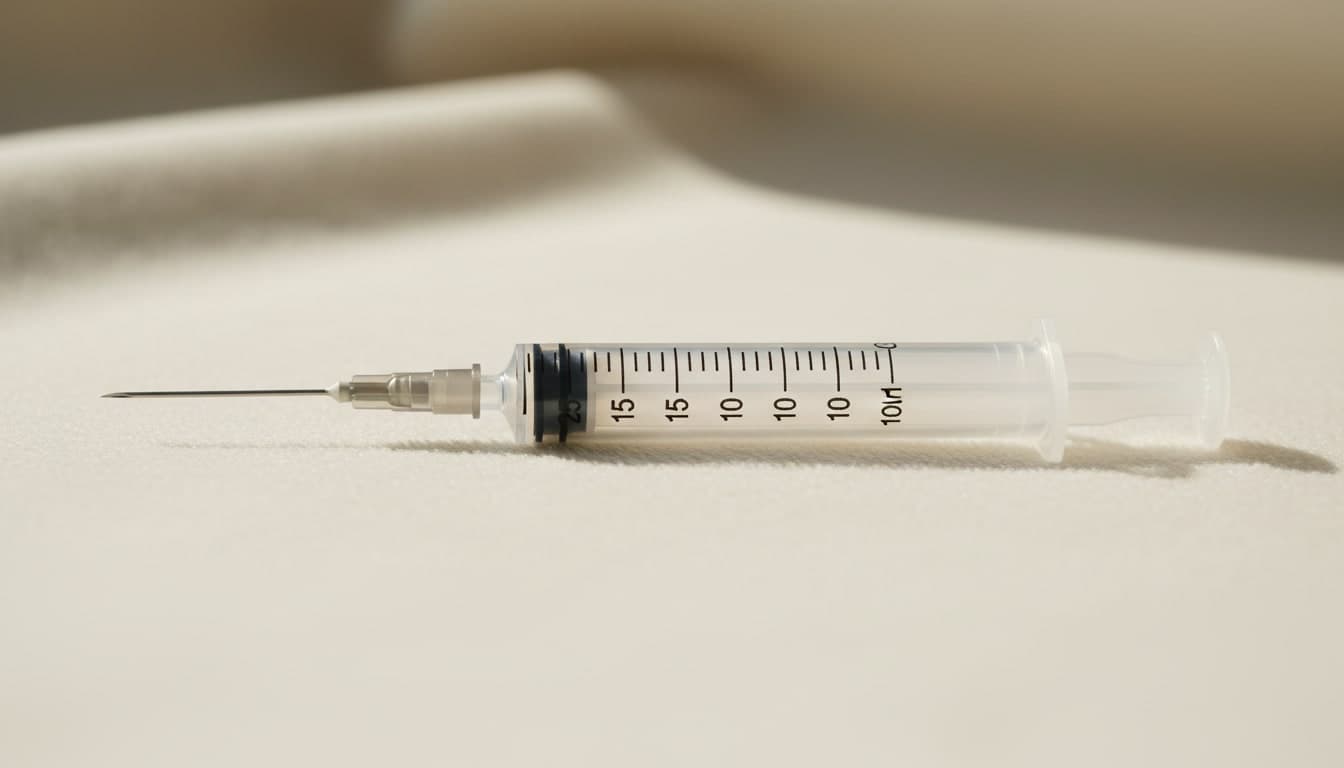
A 1 mL insulin syringe is a small (low-volume) syringe with a permanently-attached short, thin needle. Standard configuration:
- Total volume: 1 mL (the full barrel)
- Marked in 100 units (so 100 units = 1 mL)
- Each small mark = 1 unit = 0.01 mL
- Each big mark (numbered) = 10 units = 0.1 mL
- Needle: 29-31 gauge, 5/16 inch (8 mm) typically, thin enough that the injection feels like a pinprick
That conversion, 1 unit = 0.01 mL, is the whole point. It lets you measure tiny peptide doses (which can be a few hundredths of a mL) on a syringe that has visible marks at that resolution.
Why peptides use units instead of mL
A typical reconstituted BPC-157 dose is around 0.05 mL. If you tried to draw 0.05 mL on a syringe marked only in mL with marks every 0.1 mL, you'd be eyeballing half a tick. On a unit-marked insulin syringe, 0.05 mL is exactly 5 units, a precise, repeatable position.
The unit is the practical unit of measurement for peptide injection. The mL is the underlying physics, mostly hidden from the user.
The math behind the markings
Insulin syringes are designed for insulin (where dose IS measured directly in international units). For peptides, you're not measuring insulin units; you're measuring peptide volume that happens to be expressed on an insulin-syringe scale.
Concentration is what links your peptide vial to the syringe markings:
- Concentration = peptide mass / liquid volume (mcg per mL)
- Drawing X units = drawing X/100 mL = drawing (concentration × X/100) mcg
So if your concentration is 5000 mcg/mL (5 mg in 1 mL), then 10 units = 0.1 mL = 500 mcg. That's the kind of math the Reconstitution Calculator handles for you.
Gauge, what 29G vs 31G means
Gauge measures needle thickness. Higher gauge = thinner needle. Standard insulin syringes are 29G (slightly thicker, easier to draw through rubber septums quickly) or 31G (thinner, more comfortable injection but slower draw).
For most peptide users: - 29G is the all-around default. Works for both drawing from the vial and injecting. - 31G is more comfortable but can be slower to draw thicker reconstituted peptides.
Length
Most insulin syringes are 5/16 inch (8 mm), short, designed for sub-q (just under the skin). A short needle reaches the fat layer cleanly without going into muscle.
For IM injections you need a different syringe entirely, a 1-1.5 inch, 23-25G syringe. Insulin syringes are not for IM.
Reading the syringe accurately
Hold the syringe upright (needle up). Air bubbles rise to the top. Tap to dislodge any clinging bubbles, push slightly to expel a drop, then re-draw to your target unit mark.
Read the mark at eye level, looking up at it from below or down at it from above creates parallax error and you'll be a unit or two off.
Match the mark to the leading edge of the rubber plunger (the side closest to the needle). Some people accidentally read off the trailing edge and over-draw by 5-10 units.
Multi-use considerations
Each insulin syringe is single-use. Don't reuse the same syringe across days or across injections, the needle dulls quickly (one of the reasons reused syringes hurt more) and contamination compounds.
A single syringe can be used to draw bac water, then reconstitute the vial, then inject, but only as a single continuous prep+inject sequence on the same day, with the same syringe never touching anything else between vial and skin.
Storage
Insulin syringes are shelf-stable in their sealed packaging for years. Once opened, they should be kept clean and dry. Use a sharps container for disposal, most pharmacies sell them, and most also accept full ones for disposal.
Quick reference
- 1 mL = 100 units
- 0.1 mL = 10 units
- 0.01 mL = 1 unit
- Standard insulin syringe: 100-unit barrel, 29-31 gauge, 5/16 inch needle
- For sub-q only, IM needs a different syringe
The Calculator handles the conversion math. This guide is the conceptual layer for when you're staring at a syringe and want to understand what the marks actually mean.
Get the free peptide research checklist
Drop your email and we'll send you the one-page checklist for vetting any peptide before you trust a vendor or a forum: what to verify, the red flags, and the questions to ask a licensed provider. No card.
No spam, and we never sell your email. Just the checklist. Email support@pepdex.co to opt out any time.
Membership computes it once for your exact vial and saves it, and the AI Coach answers questions about your specific stack, missed doses, timing, what to watch. from $4.99/week or $29.99 for a full cycle.
Get your exact numbers →Related guides
The exact steps for mixing bacteriostatic water with a lyophilized peptide vial. Sub-q, IM, and intranasal, what changes for each.
Subcutaneous injection in plain language. Sites, angles, rotation, and the small things that prevent bruising.
What each administration route actually means, why peptides are matched to specific routes, and how to read 'route' on a peptide entry.